

Global Hearing Safe Tool Market 2026–2036: Safety Compliance and Urban Workflows Drive 6.0% CAGR
Hearing Safe Tool Market
Hearing safe tools to reach USD 2.3 billion by 2036 as compliance mandates and indoor construction reshape procurement norms.
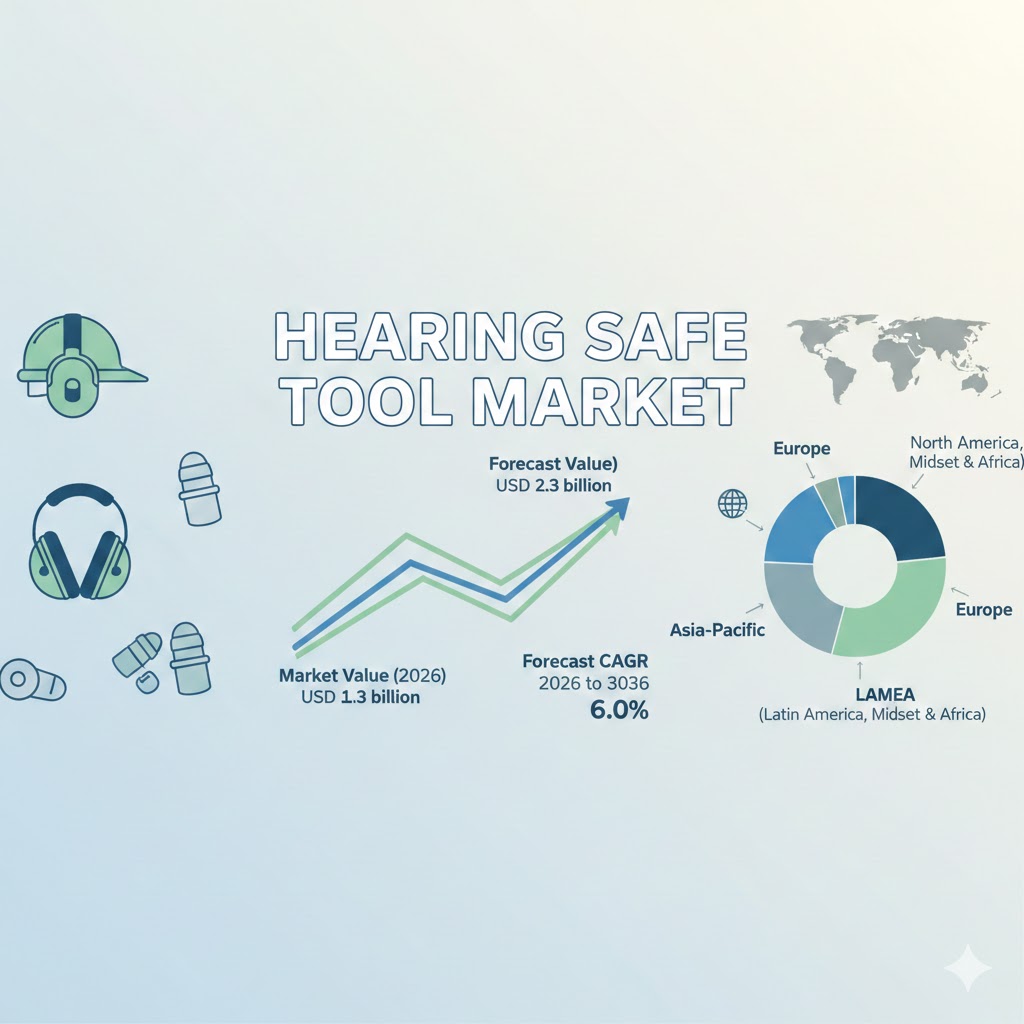
NEWARK, DE, UNITED STATES, February 19, 2026 /EINPresswire.com/ -- The global Hearing Safe Tool Market is projected to grow from USD 1.3 billion in 2026 to USD 2.3 billion by 2036, expanding at a CAGR of 6.0%. Market momentum is rooted in regulatory enforcement, workforce protection policies, and the operational need to manage cumulative noise exposure across construction, utilities, manufacturing, and maintenance sectors.
Unlike traditional equipment upgrades driven by productivity gains alone, adoption of hearing-safe tools is guided by occupational health compliance and employer liability reduction. Organizations increasingly align procurement decisions with exposure monitoring frameworks and insurance audit standards.
Request For Sample Report | Customize Report | Purchase Full Report –
https://www.futuremarketinsights.com/reports/sample/rep-gb-31300
Market Overview: Compliance-Led Equipment Modernization
Noise exposure regulations are reshaping purchasing criteria. Employers must now demonstrate engineering controls before relying solely on personal protective equipment. As a result, low-noise power tools account for approximately 48% of market demand in 2026.
Key Market Metrics
- Market Size (2026): USD 1.3 Billion
- Forecast Value (2036): USD 2.3 Billion
- CAGR (2026–2036): 6.0%
- Leading Tool Type: Low-noise power tools
- Leading End Use: Construction & Building (45% share)
- Core Regions: Asia Pacific, Europe, North America
Procurement teams prioritize certified decibel ratings, durability under load, and compatibility with centralized fleet policies over simple unit cost comparisons.
Construction Sector Dominance: 45% Market Share
Construction and building represent the largest end-use segment, contributing approximately 45% of global demand. The sector combines high decibel exposure, dispersed worksites, and intensive regulatory oversight.
Why Construction Leads:
- Constantly changing crews and equipment
- Limited feasibility of acoustic enclosures
- Public scrutiny in urban projects
- Contractual safety documentation requirements
In indoor retrofits, hospitals, data centers, and mixed-use towers, quieter tools are often the only permitted equipment class. This positions hearing-safe tools as operational enablers rather than discretionary upgrades.
Regional Growth Insights: India and China Lead Expansion
Country-level analysis highlights emerging economies as key growth accelerators.
Country CAGR Outlook (2026–2036)
- India: 6.8%
- China: 6.5%
- Brazil: 5.9%
- United States: 5.5%
- United Kingdom: 5.2%
India – 6.8% CAGR
Growth is driven by workforce formalization, infrastructure expansion, and structured safety audits. Enterprise-level procurement policies are standardizing low-noise fleets across large contractors.
China – 6.5% CAGR
Centralized purchasing by manufacturing clusters and state-linked enterprises supports scalable adoption of certified equipment.
United States – 5.5% CAGR
Demand reflects litigation exposure, insurance requirements, and enterprise-wide safety catalogs influencing fleet replacement cycles.
United Kingdom – 5.2% CAGR
Inspection regimes and contractor framework agreements shape standardized procurement behavior.
Brazil – 5.9% CAGR
Risk management practices and industrial modernization initiatives support steady expansion.
Workflow Density: The Hidden Growth Catalyst
Modern worksites are increasingly compact and multi-layered. Electricians, inspectors, installers, and technicians operate simultaneously in shared zones. Loud tools disrupt coordination and delay sequencing.
Operational Drivers of Adoption
- Parallel task execution in confined spaces
- Reduced communication interference
- Lower administrative compliance burden
- Extended permissible work intervals
In this context, quieter tools improve project scheduling efficiency and reduce downtime. Sound management becomes part of workflow engineering rather than merely a compliance statistic.
Engineering Tradeoffs and Competitive Strategy
Manufacturers face design challenges in balancing torque density, airflow management, motor configuration, and acoustic insulation. Modifications may affect weight and tactile feedback, influencing operator preferences.
Competitive Differentiators
- Verified decibel output certifications
- Ergonomic design and vibration dampening
- Durability in high-load applications
- Integration into enterprise procurement systems
Leading companies operating in the market include Bosch, DeWalt (Stanley Black & Decker), Makita, Hilti, Festool, and Metabo. Competitive positioning depends heavily on measurable acoustic performance and audit-ready documentation.
Strategic Outlook: From Safety Device to Productivity Infrastructure
Noise reduction is no longer driven solely by regulatory posters or inspection pressure. Urbanization, indoorization of construction, and mixed-trade concurrency are transforming acoustic control into a workflow variable.
As projects shift toward compact interiors and partially occupied facilities, equipment-level noise reduction becomes essential. The market’s 6.0% CAGR reflects this structural shift toward integrated occupational health planning.
Before finalizing procurement or expansion strategies, stakeholders are encouraged to align insights with long-term workforce protection objectives.
Get data that aligns with your strategic priorities — ask for report customization today:
https://www.futuremarketinsights.com/customization-available/rep-gb-31300
As mention reports url do not hyper link
Related Reports:
Japan Compact Construction Equipment Market- https://www.futuremarketinsights.com/reports/japan-compact-construction-equipment-market
United Kingdom Compact Construction Equipment Market- https://www.futuremarketinsights.com/reports/united-kingdom-compact-construction-equipment-market
Gulf Countries Compact Construction Equipment Market- https://www.futuremarketinsights.com/reports/gulf-countries-compact-construction-equipment-market
Have a specific Requirements and Need Assistant on Report Pricing or Limited Budget please contact us - sales@futuremarketinsights.com
About Future Market Insights (FMI)
Future Market Insights, Inc. (FMI) is an ESOMAR-certified, ISO 9001:2015 market research and consulting organization, trusted by Fortune 500 clients and global enterprises. With operations in the U.S., UK, India, and Dubai, FMI provides data-backed insights and strategic intelligence across 30+ industries and 1200 markets worldwide.
Contact Us:
Future Market Insights Inc.
Christiana Corporate, 200 Continental Drive,
Suite 401, Newark, Delaware - 19713, USA
T: +1-347-918-3531
Why FMI: https://www.futuremarketinsights.com/why-fmi
For Sales Enquiries: sales@futuremarketinsights.com
Website: https://www.futuremarketinsights.com
LinkedIn| Twitter| Blogs | YouTube
Sudip Saha
Future Market Insights Inc.
+1 347-918-3531
email us here
Legal Disclaimer:
EIN Presswire provides this news content "as is" without warranty of any kind. We do not accept any responsibility or liability for the accuracy, content, images, videos, licenses, completeness, legality, or reliability of the information contained in this article. If you have any complaints or copyright issues related to this article, kindly contact the author above.
